
A Sermon for the Fifth Sunday After the Epiphany (Isaiah 6:1-13; Luke 5:1-11)
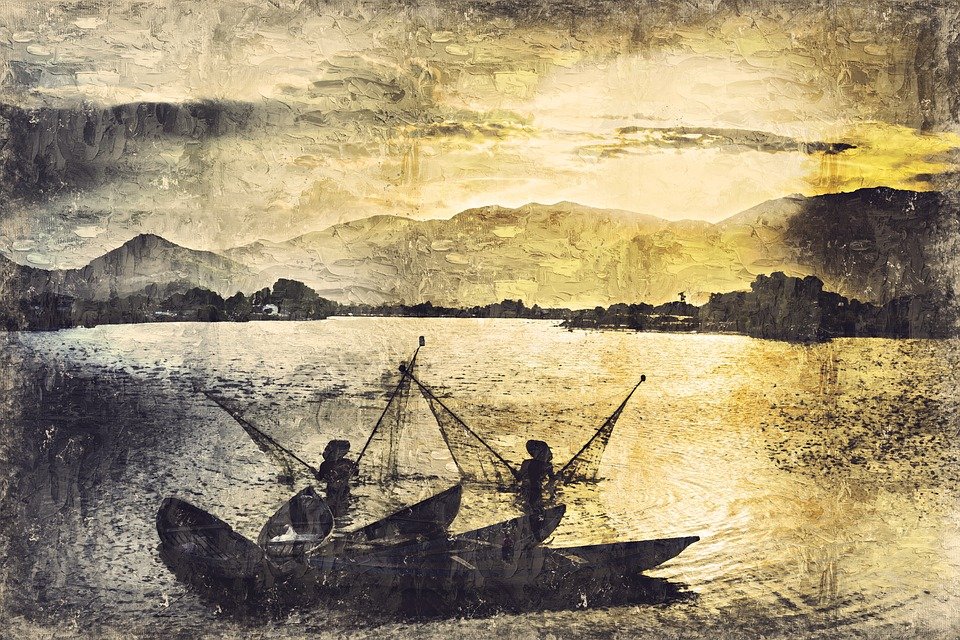
They cast their nets in Galilee,
Just off the hills of brown;
Such happy, simple fisherfolk,
Before the Lord came down,
Contented, peaceful fishermen,
Before they ever knew
The peace of God that filled their hearts
Brimful, and broke them too,
During the season after the Epiphany every year, we encounter several themes in our Gospel readings. From the story of Gentile kings drawn to the birth of Jesus by a star, symbolic of the spreading of God’s light to the world, to Jesus’ baptism and calling by God. From the first miracle of Jesus at the wedding at Cana to ultimately his Transfiguration. All of these scenes show God’s light spreading to the world, and the world is responding.
This morning, we hear that as his ministry is officially beginning, Jesus needs to “build his team” as we might say. He must find helpers, people willing to learn from him and be willing to help in his mission, and it’s a big one – to call the world back to God, whatever the cost.
In today’s Gospel, we hear what I would dare describe as a familiar scene: Peter, here called Simon, along with James, and John, these three who would become Jesus’ inner circle of disciples. They are fishing in the Sea of Galilee, nothing unusual there. But they’re having a hard time at it, and Jesus, after he is done teaching, gives them some fishing advice. Do you wonder if they rolled their eyes at first? “What does rabbi know?” The result is nothing short of stupendous, helping them catch two boat-LOADS of fish. It would be the first of many times Jesus would astound them.
I’ll be the first to admit that for years I had many misconceptions about this scene. I think it may go back to my childhood, to illustrations in children’s bibles and stories from Sunday School. We learned that Peter and the rest were what the hymn I quoted at the opening of my sermon calls, “Happy, simple fisherfolk.”
We have these images of salty fishermen in their boats, casting nets into the sun-washed sea. To quote the hymn again, “Contented, peaceful fishermen.” As a child, I guess I always assumed when Jesus came by, they must have been a little bored with fishing, especially when there was no catch. NOT an exciting way to make a living! You can almost hear them “Nothing ever happens here. Yawn!” So the first chance they got, they dropped their nets and followed Jesus. “Finally! Some excitement!”
Then as I grew older and continued to hear this story, my focus changed. I grew worried about their father, Zebedee. Poor Zebedee! How must he have felt when his sons took off, leaving him literally holding the net. These new disciples had abandoned the family business! Oh no! Jesus, I hope you know what you’re doing!
But the more you read, the more you learn. Little did I know how revolutionary this seemingly simple act actually was. While studying this passage, I came across an article by a New Testament scholar (K.C. Hanson), who gives us details what the fishing industry on the Sea of Galilee must have been really like. There will be a link to the original article posted on my sermon blog.
Their research of Roman and other records of the day, revealed that these weren’t just simple fishermen, out for a hot day’s work, who would then take their catch back and sell it in the local fish market and, of course, keep some aside for their families. The fishing industry in Galilee was just that, an industry! It was not the small scale, local, “free enterprise” system we often imagine. Remember this was occupied territory! The Romans were in charge. The fishing industry was overseen by the Judean authorities, namely Herod’s men, who were managing it for their Roman overlords. Their boats were licensed. Their profits, if there were any, were heavily taxed. Rather than working to support their families, Simon Peter, James, and John were working ‘for the man’. They were part of the “system”.
The article gets pretty technical, complete with flow charts to show who owed tribute to whom, and who you had to bribe. There were tax collectors and fish distributors, boat builders and salt merchants, buyers and sellers of just about everything. Needless to say, it was a complex system, full of bureaucracy and corruption. Just to get the fish from the Sea of Galilee to the table of your local Galilean family was not so easy. And these local fishermen were at the bottom of the flow chart. They didn’t call any shots. They had no power. They worked hard to make a living, with sweaty, sunburnt foreheads and scarred hands. So much for happy, simple fisherfolk, contented and peaceful.
They worked under pressure. No wonder Simon Peter was panicked and frustrated. They were caught in a corrupt system that had no future. This was the life Jesus was calling them to leave. Don’t think they regretted it for a minute! But it was a bold move!
Think of later, when we hear the story of Jesus calling Matthew the tax collector to leave behind his life as another cog in the imperial wheel. This was a major decision, one with great consequences. Jesus called them all to walk away from businesses that were probably choking the life and the spirit out of them. Change your minds, Jesus says, turn around. Stop working for the Roman empire and and work for God’s kin-dom instead. It took great courage for these men to walk away from the system, to choose an alternative. But, alas, poor Zebedee was still left holding the net.
Now, when I read this story through a different lens, I can see how radical their encounter with Jesus was.
“Don’t be afraid! Leave your nets. Come, work for me instead!” They would fish for people, as Jesus promised. They would turn away from years of oppression and turn their sights toward liberation.
We witness another calling of God this morning in our reading from Isaiah. It’s an impressive scene, with angels and special effects that sound like they’re from The Wizard of Oz. The shock of this vision and God’s call humbles Isaiah. “Woe is me! I am lost, for I am a man of unclean lips, and I live among a people of unclean lips”. Where do we hear this sentiment repeated this morning? When the miracle of the great catch of fish stuns Peter, he sinks to his knees and cries out, ‘Go away from me, Lord, for I am a sinful man!’
In neither case is this an excuse. Of course God knows Isaiah’s sinfulness. And Jesus, though he doesn’t know Peter yet, knows that this fisherman has probably done many things in the industry over the years that he is ashamed of. All that is asked of both Isaiah and Peter is willingness and obedience, not perfection. When God calls, God will show the way. All of this comes down to God calling and Isaiah responding, “Here I am. Send me.”
We have so many other examples in the story of God’s people. God called Abraham – to leave everything and follow God’s plan to give birth to a people. God called Jonah, and though he tried to run from the calling, Jonah wound up fulfilling God’s call in the end. God called a young, Jewish girl in Nazareth to trust a plan that must have blown her mind. Mary would give birth to Emmanuel, God with us, but she wasn’t forced. The miracle happened because of her willingness and obedience.
Of course following God’s call doesn’t always end with happy scenes of contentment and peace. So many of the people Jesus calls to follow him wind up hunted, and many of them were killed for their faith.
The third verse of that hymn actually reflects this reality:
Young John, who trimmed the flapping sail,
Homeless in Patmos died.
Peter, who hauled the teeming net,
Head down was crucified.
In our own time, God has called many individuals to leave the life they knew to live a life of radical obedience. Mother Theresa left a life of privilege to live with lepers in Calcutta. God called Dr. King, a respected pastor, to step out from behind his pulpit and challenge unjust systems, even if it cost him his life. Episcopal seminarian, Jonathan Daniels, put his priestly studies on hold to help register black voters in the Deep South. He died protecting a young, black woman from death. There are countless others, heroes of our faith who have worked to change the system right where they were.
I don’t know about you, but I know I have been asking myself “What is God calling me to do?” in recent days. It hasn’t even been three weeks since the inauguration. In my work at Rutgers I am hearing fear from students. One student confessed to me in private that his parents are undocumented. Our ministry at The Canterbury House has many trans and non-binary individuals gathering as a community of faith. The fear and uncertainty is real. One student changed their legal documentation to read “X” instead of “male” or “female”. Now they feel very conspicuous. They’re on a list. If they were to leave the country, even as a natural-born citizen, they fear they may not be let back in.
My heart breaks and my anger rises as more comes to light. We don’t know what the future ultimately will hold. But we know that others have trod these paths before us. I’ve been re-reading James Baldwin and Maya Angelou, among others. We need their wisdom and their courage these days.
What is God calling me to do? What is God calling you to do? What is God calling us to do? I’m not sure yet, exactly. Let me know if you know! We must remember our baptismal promises: to strive for justice and peace, and to respect the dignity of every human being. How hard will that get? Only God knows. But the calling on our lives remains. If God’s people don’t bring light and hope to the world, who will? This may not make us popular – ask Bishop Marianne Budde. But God is faithful and will give us the strength we need for the struggle ahead.
We are all called to be part of the coming of God’s Commonwealth, God’s kin-dom. We are all called to challenge injustices whenever we encounter them. To stand with the oppressed. To march with the marginalized. From racism to fear of the immigrant. We are called. From the trans community to those who have limited or no access. We are called to speak up for those who have no voice. We are called to feed the hungry, clothe the naked, be the hands of Christ in the lives of those without homes or hope.
Epiphany is a season of light and revelation. Let our lives reflect that light, the light of Christ, no matter how deep the darkness may seem. All we need say is “Here am I, send me.”
The last verse of that opening hymn may surprise you. I know it did me. From describing simple, contented, peaceful fisherfolk to the destiny of God’s servants.
The peace of God, it is no peace,
But strife closed in the sod.
Yet, let us pray for but one thing:
The marv’lous peace of God.
Amenhttps://www.kchanson.com/ARTICLES/fishing.html

 Life is a journey, not a guided tour